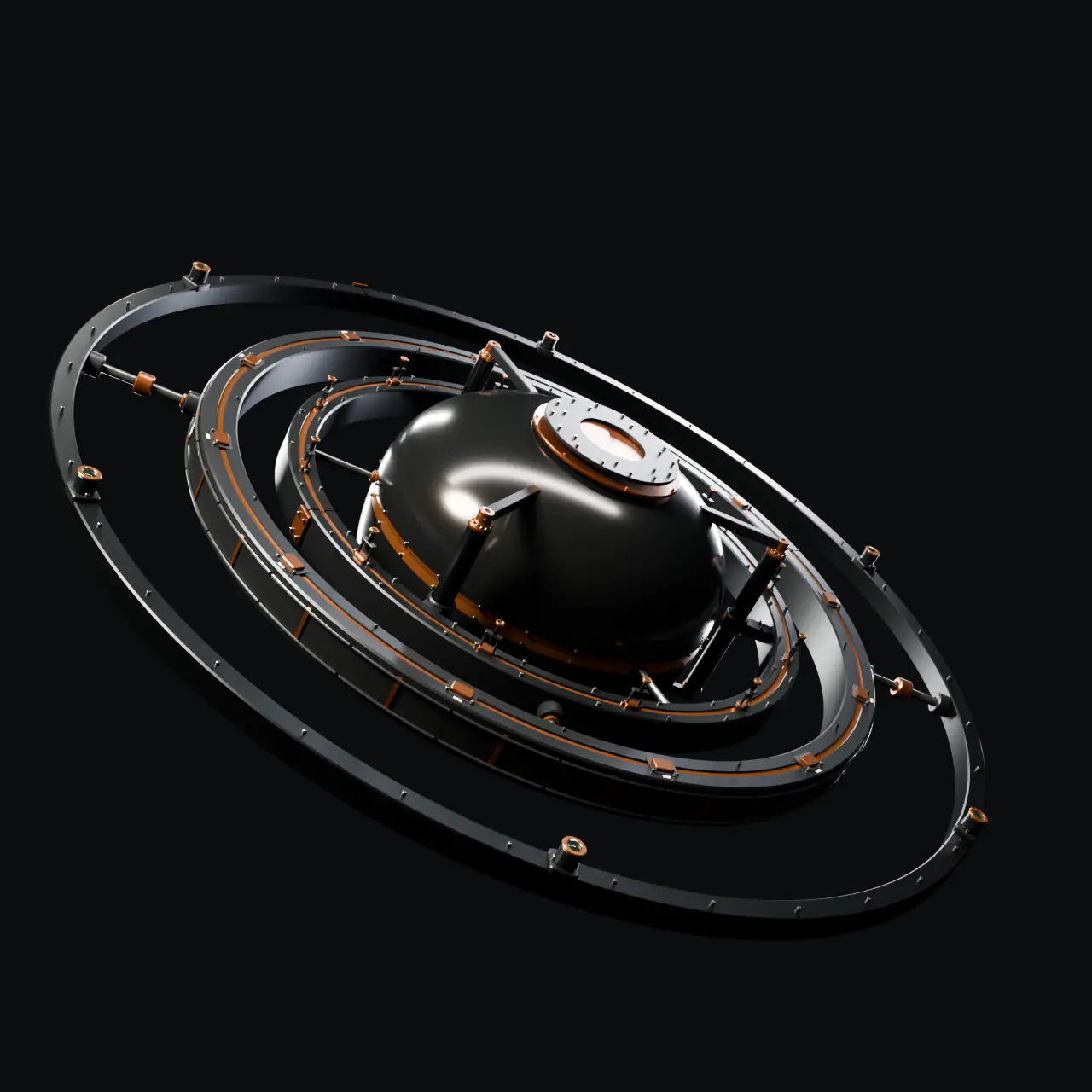
Possible Matter: An instrument, imagined.
Every object rendered here is imagined or illustrative. The flat line drawings in chapter 08 are schematic summaries of demonstrated evidence, not plotted data: a solid line follows what is observed, a dashed line what visible matter alone would predict, a hollow form marks mass inferred from gravity, and the word unknown marks what is not yet known. The scale bar is solid when illustrative, dashed when compressed, hollow when mass is inferred, and broken when not to scale. Scroll to open the instrument; scroll back to close it.
01
The unresolved instrument
Closed, it could be any size.
Scale: about one metre; illustrative.
- Three guides carry the shell apart. Nothing opens without support.
- The joints lock. Three apertures come into line, and light passes through.
- At the center, a seed.
- A speculative study
An instrument for making possibilities examinable. It has no single scale. Its shell protects a seed, its rings carry loads, its apertures align a path of light. As it opens, the same forms return at other sizes with other jobs. None of it is a product.
A kinematic model with supported guides and connected release paths. No dimension shown is a specification, and nothing here is a design for a physical machine.
02
Architecture below the surface
The shape inside a material decides what it can do.
Scale: about one centimetre; illustrative.
- Inside, the structure is graded: dense where loads gather, open where they do not.
- Under load the open region gives and the dense region holds. Drawn, not calculated.
- Three architectures, one substance. Only the shape changes.
- An active research frontier
- A speculative study
Struts, pores, membranes, and graded regions decide how a material bends, insulates, conducts, or fails. Architected materials borrow their behavior from geometry as much as chemistry.
Below the shape, solid matter is mostly fields and binding energy: almost all of a proton's mass comes from the energy binding its quarks and gluons. Empty space has measurable effects. States of matter beyond solid, liquid, gas, and plasma have been made on purpose: Bose–Einstein condensates (1995), quasicrystals (found 1982), time crystals (reported 2017). The deformation shown is illustrative, and no material property is claimed.
03
A machine that makes the next machine
A part is held before it is made.
Scale: about ten metres; illustrative.
- Before anything is shaped, it is located and held.
- The part grows along a planned path, inside its containment.
- A probe measures it along the same thread of light.
- The finished part leaves on the rail.
- Based on demonstrated research
- An imagined future system
A blank arrives, is located, held, shaped, measured, and released. The cell is drawn as a chain of custody rather than a black box. The part it finishes is the structural module the next place is built from.
Metal printing was demonstrated aboard the International Space Station in a limited experiment (ESA, 2024). The complete cell shown here is imagined.
04
Industry that belongs to its place
Dust, heat, and a two-week night shape everything here.
Scale: about one kilometre; illustrative.
- Dust wears down everything it touches, so dirty and clean work are kept apart.
- Heat can only leave as radiation. The largest structures are radiators.
- Two weeks of light, then two weeks of dark. Power covers the ground.
- Based on demonstrated research
- An imagined future system
A factory on the Moon cannot borrow Earth's habits. The site separates dirty from clean, gives waste heat a visible architecture, keeps repair routes short, and treats power as a landscape. The layout follows the constraints.
NASA extracted oxygen from lunar soil simulant in a vacuum test (2023). An operating lunar factory is a much larger step. No production rates or yields are shown or implied.
05
Structure for uncertainty
Most of this machine protects a very small part of it.
Scale: about one metre; illustrative.
- The active region is small. The rest shields, cools, and controls it.
- Signals go in and readings come out, in a timed sequence.
- Errors are expected. The structure finds and corrects them, over and over.
- An active research frontier
- A speculative study
Some computation depends on states that are fragile by nature. Shielding, cooling, control lines, and careful timing surround a small active region. It is a structure for working carefully with uncertainty; it does not know everything at once.
One physical basis is depicted for consistency: superconducting circuits in a dilution refrigerator. The diagrams are illustrations. No speed-up or working algorithm is claimed.
06
Systems that can be repaired
What lasts is what can be repaired.
Scale: about five hundred metres; illustrative.
- Air, water, light, warmth, and time to fix what breaks.
- A worn module is released along the joint that holds it.
- A new one seats in its place. The high point is a repair.
- A speculative study
The ring that once carried the instrument now carries life. Its panels are replaceable and its corridors exist for service. When a worn module is lifted out and a new one seated, nothing that mattered is lost.
A speculative habitat. Any implied rotation is qualitative. No claim is made about a solved closed ecosystem.
07
The sea of light
A message sent from here is still on its way.
Scale: about one astronomical unit, then ten light-years, then a hundred thousand light-years, compressed; then about a billion light-years, illustrative.
- Collectors, workshops, and relays, spread thin. A message leaves.
- The view widens. The message is still traveling.
- Between galaxies, travel belongs to deep time. Nothing here outruns light.
- The map is compressed to fit a screen, and it says so.
- A speculative study
- An imagined future system
At these scales nothing is instant. Coordination has to wait, and memory has to be built into the infrastructure.
Scale is compressed and marked at every step. Light-travel delay is real; the network is imagined; the star field is illustrative, not a catalogue. Andromeda is about 2.5 million light-years away. No faster-than-light system is depicted.
08
The unseen
Most of the universe does not shine.
Scale: about a hundred thousand light-years for the galaxy and a million light-years for the lens, where mass is inferred from gravity; about a billion light-years for the expanding grid; the curvature sheet is not to scale.
- The outer stars of a galaxy move too fast for the matter we can see.
- Light bends around more mass than the visible galaxies there can explain.
- The expansion is speeding up. Nothing known explains why.
- Gravity is the best-tested force at large scales, and untested at the smallest.
- Based on demonstrated research
- An open question
About one twentieth of the universe is the kind of matter this page is made of. The rest is known only by its gravity and by the way the expansion behaves. The instrument cannot show what these things are. It can show where the evidence is and where the gap begins.
Measurements of the cosmic microwave background give about 5% ordinary matter, 27% dark matter, and 68% dark energy. Rotation curves, gravitational lensing, and the accelerating expansion (Nobel Prize 2011) are demonstrated; what dark matter and dark energy are is not known. General relativity has passed every test so far, including gravitational waves (detected 2015) and images of black-hole shadows (2019, 2022). No quantum theory of gravity has been tested. Every diagram here is an illustration, not a simulation.
09
The instrument that remembers
Build what matters. Leave it understandable.
Scale: about one metre; illustrative.
- Inside, the same ideas in several forms: pictures, words, diagrams, units.
- Kept so that someone who was not here can rebuild the meaning.
- This page carries its own description in the same way.
- A speculative study
The network resolves into something small enough to hold: an archive whose outer form is the seed you first saw. Inside it are pictures, words, diagrams, units, and a plain description a machine can read.
The public description of this work is a plain document: possible-engine.json. It states, chapter by chapter, what is demonstrated, what is research, what is imagined, and what is an open question.
Possible Matter is a future taking shape through DrMatcha Studio.
DrMatcha Studio © 2026